-


-


-


-


whatsapp

-
WeChat


Hydraulic hoses: a complete guide to selection and reliability
2026-03-24
content
- Introduction: The circulatory system of modern technology
- Anatomy of a hydraulic hose: what does it consist of?
- Classification and standards: how to read labels
- Selection criteria: STAMPED formula
- Installation and installation: the art of preventing failures
- Diagnostics, maintenance and replacement
- Safety first
- Economics: Price vs. Cost of Ownership
- The future of hydraulic hoses
- Conclusion
Introduction: The circulatory system of modern technology
In the world of heavy industry, construction, agriculture and aviation, there is an invisible but critical element that keeps machinery alive. Just as blood vessels deliver oxygen and nutrients to the organs of the human body,hydraulic hosestransport energy in the form of a high-pressure liquid to the actuators of machines. Without them, the excavator will not be able to lift the bucket, the press will not form the part, and the aircraft will not lower the landing gear.
However, despite their fundamental role, hydraulic hoses are often perceived as a consumable item, a minor component on which to save money. This is a dangerous misconception. A hydraulic line failure can not only result in expensive equipment downtime and loss of production, but also serious personal injury due to a pressure line rupture or hydraulic oil fire. Choosing the right hose isn't just about buying a rubber tube; This is an engineering task that requires a thorough understanding of operating conditions, material properties and safety standards.
This is why choosing a reliable supplier partner becomes as important as the technical selection of the component. The company has established itself in the markets of Russia, Kazakhstan, Uzbekistan and other CIS countriesZhengzhou Haida Hydraulic Technology Co.,Ltd. Specializing in the field of hydraulic fluid transmission and control, the company offers a wide range of solutions: from standard hydraulic hoses and industrial tubing to ultra-high-pressure polymer systems. Deep integration into the regional industrial sector allows the company to provide customers with not just products, but durable and efficient fluid handling solutions that meet the most stringent operating requirements, serving as a reliable business service partner.
In this detailed guide, we will cover all aspects related tohydraulic hoses: from their internal structure and classification to the nuances of selection, installation and maintenance. Our goal is to provide you with comprehensive information to help you make informed decisions, improve the reliability of your equipment, and ensure safe work processes.
Anatomy of a hydraulic hose: what does it consist of?
To understand how to choose a reliable product, you must first understand its structure. Modernhydraulic hoseis a complex multi-layer product, where each layer performs a strictly defined function. Ignoring the characteristics of any of these layers can lead to premature failure of the product.
Inner layer (Tube)
This is the heart of the hose, in direct contact with the working fluid. Its main task is to ensure tightness and chemical resistance. The inner layer material must be inert to the hydraulic oil used and will not swell, crack, or release particles that could clog valves or pumps. Most often, synthetic rubber (for example, nitrile rubber NBR), thermoplastics (polyurethane, nylon) or Teflon (PTFE) are used for these purposes. The choice of material depends on the type of fluid: standard mineral oils, biodegradable ester-based fluids, aggressive chemicals or high-temperature environments require different solutions.
Reinforcement layer
It is this layer that determines the working pressure of the hose and its ability to withstand impulse loads. Without reinforcement, the rubber tube would simply swell and burst under pressure. The following are used as a reinforcing element:
- Textile braid:Used in low pressure hoses. It is flexible, but not designed for heavy loads.
- Steel Braided (Braided):One or more layers of steel wire woven around an inner layer. Hoses with one braid (1SN, R1AT) are suitable for medium pressures, with two braids (2SN, R2AT) - for high pressures. The braid provides good flexibility.
- Steel winding (Spiral):Several layers of wire wound in a spiral. Such designs (4SP, 4SH, R13, R15) are designed for extremely high pressures and heavy impulse loads. They are less flexible than braided ones, but are much stronger and more durable in harsh conditions.
Outer layer (Cover)
This is hose armor that protects the inner layers from external influences. The quality of the outer layer is often underestimated, but it is the one that takes the blows of abrasive wear, exposure to ultraviolet radiation, ozone, oils, acids and extreme temperatures. Modern exterior coatings can be abrasion resistant (MSHA - Mine Safety and Health Administration marking), fire resistant, or have special markings for identification. Damage to the outer layer allows moisture and dirt to reach the metal fittings, causing corrosion and subsequent rupture of the hose.
Classification and standards: how to read labels
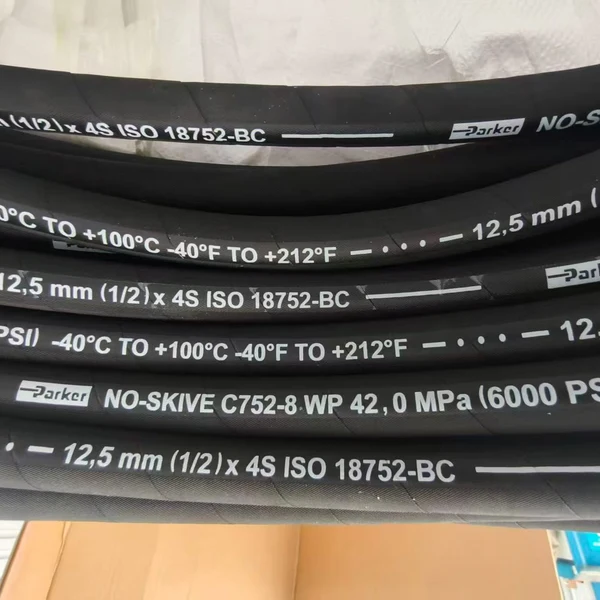
Markethydraulic hosesregulated by many international and national standards. Understanding this acronym is key to selecting the correct component. The most common standards are ISO, SAE (Society of Automotive Engineers) and EN (European Norm).
SAE and ISO standards
In North America, the dominant standard is SAE J517, which divides hoses into series (eg, 100R1, 100R2, 100R12, 100R13). In Europe and Russia, ISO 1436 and EN 853/856 standards are widely used. Although the designations may differ, their technical parameters often overlap. For example:
- R1AT/1SN:Single braid hose for medium pressures. Often used in return or low pressure lines.
- R2AT/2SN:Double braid hose. The most popular type for the main hydraulic lines of mobile equipment, operating at high pressures.
- R12 / R13 / R15 (or 4SP / 4SH):Multilayer coiled hoses. R15 is the most powerful in this group, capable of withstanding pressures of up to 400-600 bar or more depending on the diameter. They are indispensable in hydraulic hammers, presses and drilling rigs.
Thermoplastic and Teflon hoses
In addition to traditional rubber-fabric structures, there are specialized types. Thermoplastic (TP) hoses are lightweight, resistant to hydrolysis and are often used in pairs (duplexes) to control machinery. Teflon hoses (PTFE) have unique chemical resistance and operate over a wide temperature range (-60°C to +260°C), but require special attention during installation due to the risk of kinking and the need for special fittings.
Selection criteria: STAMPED formula
How to choose the perfect onehydraulic hosefor a specific task? Professionals use the STAMPED mnemonic rule, which covers all critical parameters. Neglecting any of these points reduces the service life of the product significantly.
S - Size
The size is determined by the internal diameter (ID). Incorrect selection of diameter leads to problems. Too small a diameter increases the fluid flow rate, which causes turbulence, pressure drop, overheating of the system and erosion of the inner layer. Too large a diameter makes the system bulky, expensive and makes it difficult to lay the route. Selection is made based on the required fluid flow (l/min) and permissible flow speed (usually 3-6 m/s for pressure lines).
T - Temperature
It is necessary to take into account both the temperature of the working fluid itself and the ambient temperature. Standard hoses are typically rated from -40°C to +100°C. If temperatures exceed these limits, special materials are required. It is also important to remember that fitting temperatures may be higher due to heat transfer from adjacent components.
A - Application
Where will the hose go? On a stationary machine or on a moving boom of an excavator? In a mine or food production? Application conditions dictate requirements for flexibility, abrasion resistance, fire resistance and the availability of special certificates.
M - Media (Wednesday)
The type of hydraulic fluid is critical. Mineral oils, water glycol, phosphate esters, vegetable oils - they all have different effects on rubber. For example, standard nitrile rubber will quickly deteriorate when in contact with phosphate esters (used in aviation), but butyl rubber or PTFE will be required. Always check the manufacturer's chemical compatibility charts.
P - Pressure
The hose operating pressure must be greater than the maximum operating pressure of the system. But it is even more important to take into account the peak pressure surges (pulses) that occur when the valves operate suddenly. The rule is: the operating pressure of the hose must be no less than the maximum pressure in the system. However, for systems with frequent water hammer, a safety margin is recommended. Never use a hose if its pressure rating is lower than the pressure relief valve setting.
E - Ends
The type of fittings must match the ports of the equipment. There are many thread standards: metric, inch (BSP, NPT), flange connections (SAE, Komatsu, Caterpillar). An error in thread selection will lead to leaks or thread failure under pressure. The installation angle of the fitting (straight, 45°, 90°) is also important to ensure accurate installation without twisting the hose.
D — Delivery (Delivery/Installation)
This point is often overlooked, but it concerns the length of the hose and how it is routed. The hose must be of sufficient length to compensate for changes in geometry when the mechanisms move (elongation under pressure up to 4%, bends during cylinder operation). A stretched hose is doomed to rapid failure.
Installation and installation: the art of preventing failures
Even the most expensive and high-qualityhydraulic hosewill fail in a matter of hours if it is not installed correctly. Statistics show that a significant portion of hydraulic failures are associated precisely with installation errors.
Avoiding twisting
When tightening fittings, the hose should not twist around its axis. Even a slight misalignment (5-10 degrees) sharply reduces the service life of the reinforcement due to uneven stress distribution. Many hoses have a longitudinal marking line - this should remain straight after installation. A kinked hose may burst when pressure is applied.
Bend radius
Each hose has a minimum bend radius specified in the specifications. Bending a hose with a radius smaller than recommended will result in flattening of the internal channel, restriction of flow and, more dangerously, damage to the steel reinforcement at the bend point. The wire may begin to break, causing the hose to bulge (“herniate”) and then rupture. Use elbow fittings if the route requires a sharp turn, rather than bending the hose itself.
Protection against abrasion and external influences
In places where the hose may come into contact with other hoses, the machine body or moving parts, it is necessary to use protective hoses (spiral or fabric), plastic casings or special covers. The friction of two hoses against each other during vibration can wipe the outer layer down to metal in a very short time. You should also avoid laying hoses near heat sources (exhaust manifolds, mufflers) unless they have special thermal protection.
Length compensation
Under pressure, the hydraulic hose lengthens slightly (up to 2-4% depending on the design) and decreases in diameter. When laying between moving units, it is necessary to leave slack (loops) that will allow the hose to move freely without tension. The tension causes the fittings to pull out or the braid to break.
Diagnostics, maintenance and replacement
Regular inspection of hydraulic lines is the basis of preventive maintenance. Visual inspections should be carried out daily or before each shift. What to look for?
- External damage:Cuts, abrasions to the cord, cracks on the outer layer (“crocodile skin effect” indicates aging of the rubber or exposure to ozone/temperature).
- Bloating:Local expansion of the hose indicates damage to the internal fittings. This hose must be replaced immediately.
- Leaks:Any traces of oil on the hose or at the fitting connection are unacceptable. Remember that a thin stream of high-pressure oil may not be visible, but can penetrate the skin, causing severe injuries (injection injuries).
- Hardness:If the hose has lost flexibility and has become “woody”, this is a sign of material degradation.
Service lifehydraulic hosesnot infinite. Even under ideal storage and operating conditions, rubber ages. The recommended storage period for hoses before commissioning is usually no more than 2-3 years from the date of production (indicated on the label). After installation, the average service life depends on the intensity of work, but planned replacement after a certain service life (motor hours) is often more economically feasible than eliminating the consequences of an accident.
Safety first
Working with high pressure hydraulic systems poses serious risks. A ruptured hose can turn the oil stream into a cutting tool that can cause fatal injuries. In addition, atomized hydraulic oil is highly flammable upon contact with hot surfaces.
Never look for a leak with your hands! Use cardboard or a piece of wood. Before any hose replacement or repair work, be sure to relieve the pressure in the system and ensure that it is zero. Use personal protective equipment (goggles, gloves, overalls). When installing new hoses, make sure they meet the safety requirements for the industry (for example, fireproof underground hoses).
Economics: Price vs. Cost of Ownership
When purchasinghydraulic hosesThe temptation to buy the cheapest option is great. However, in the long run, skimping on quality can result in colossal losses. A cheap hose can fail within a month, causing:
- Downtime of equipment (the cost of an hour of operation of an excavator or press is often hundreds of dollars).
- Hydraulic oil loss and environmental pollution.
- Risk of personal injury and associated legal and insurance costs.
- Damage to other system components (pumps, valves) due to the ingress of rubber crumbs or metal from a collapsed hose.
Investment in high-quality hoses from trusted manufacturers that meet all standards pays off in the reliability and predictability of equipment operation. Cost of ownership (TCO) includes not only the purchase price, but also installation, maintenance, downtime and replacement costs. A quality product will minimize all of these hidden costs.
The future of hydraulic hoses
The industry does not stand still. Technology development is aimed at creating even more reliable and smart solutions. Hoses are emerging with built-in sensors that can monitor pressure, temperature and vibration in real time, transmitting data to a telematics system to predict remaining life (Predictive Maintenance). New composite materials are being developed that provide less weight with greater strength, as well as coatings that self-heal when microdamaged. Environmental requirements stimulate the creation of hoses that are fully compatible with new generations of biodegradable oils and operate in extreme conditions without harm to nature.
Conclusion
Hydraulic hoses- these are not just connecting elements, they are a guarantor of the safety and efficiency of the most complex mechanisms. The right choice, based on a thorough analysis of operating conditions (pressure, temperature, environment, dynamics), competent installation in compliance with all technical standards and regular maintenance can maximize the service life of these components.
Remember: a hydraulic system is only as reliable as its weakest link. Don't let this link cause an accident. Choose hoses professionally, trust trusted suppliers and do not ignore manufacturers’ recommendations. In the world of high energy and enormous forces that modern hydraulics operate, there is no room for compromise in terms of quality and safety. By investing time and resources in the right selectionhydraulic hoses, you invest in the continuity of your business and the safety of human lives.
We hope that this guide has become a useful tool for you in working with hydraulic systems. Use the knowledge gained to optimize your equipment fleet and improve the overall production culture.