-


-


-


-


whatsapp

-
WeChat


Forward together: key points for safe operation and maintenance of hydraulic hoses
2026-05-09
The safety of the hydraulic system is of paramount importance and covers the entire cycle: selection, maintenance and timely replacement of hydraulic hoses. Hydraulic hoses are connected to cylinders that transmit working force. When they fail, serious emergency situations arise. For example, a hose rupture during loader operation can lead to sudden closure of the bucket or uncontrolled spillage of the load. When working at height, such malfunctions create even higher risks.
Creating and maintaining safe working conditions is the basis of the production process. Regular reminders to personnel of basic safety rules help minimize the risk of serious consequences. When operating hydraulic equipment, it is necessary to take into account regular maintenance, fluid leaks, system contamination, temperature conditions and acceptable operating pressure levels.

Equipment Safety and Maintenance Standards
1.Organization of regular scheduled maintenance
2. Elimination of ignoring any leaks of working fluid
3. Timely replacement of worn and damaged elements
4.Prevention of contamination of the hydraulic system

5.Maintaining optimal operating temperature conditions
6. Strict prohibition on exceeding the maximum operating pressure
7.Analysis of the causes of malfunctions of hydraulic hoses

Why is a preventive maintenance plan necessary?
A comprehensive preventative maintenance plan brings significant benefits to businesses: cost savings and overall employee safety. The main advantages of implementing the plan:
- Increased equipment performance and workflow stability
- Optimizing the distribution of labor resources, reducing the number of emergency repairs
- Precise control of warehouse balances and consumables, reducing spare parts losses
- Reduce unplanned equipment downtime
- Minimizing production risks and enhancing the level of industrial safety
- Extends the life of all hydraulic equipment
- Reducing capital costs by preventing premature wear of equipment
- Reducing the cost of emergency repairs and breakdowns
Important Warning
The hydraulic hose is a small element in the design of the hydraulic system, but neglect of its timely maintenance and operation in violation of standards lead to serious equipment breakdowns and dangerous industrial accidents.
Comparing the benefits of stripped and non-stripped hydraulic hose assemblies
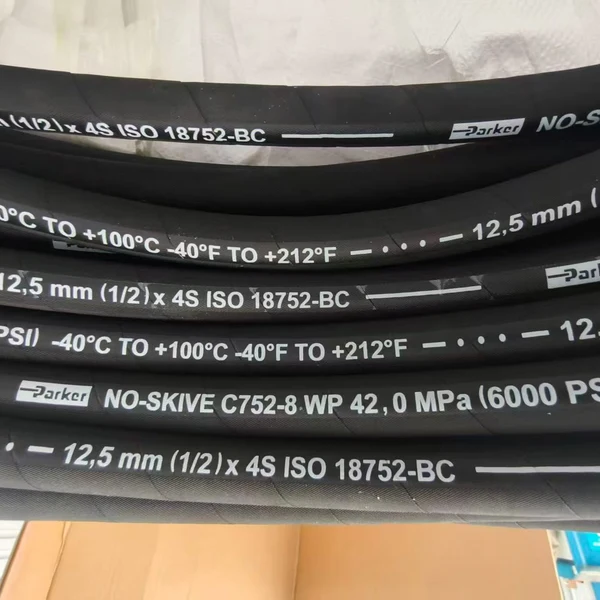
Stripping technology is the process of removing the outer or inner rubber layer of a hydraulic hose before installing the fittings. No-stripping technology involves a special design of the hose and fittings that allows direct assembly without removing the rubber layer. The main difference between the two technologies is the thickness of the outer rubber layer. Thicker outer layers require specially designed hydraulic fitting bodies to accommodate the thickness.

Analysis of the advantages of hoses without stripping
By maintaining the integrity of the outer and inner rubber layer, the no-stripping technology eliminates damage to the hose structure when crimping fittings. This technology not only significantly reduces the assembly time of the hose assembly, but also eliminates the need for additional equipment and cleaning work. Equally important, properly selected hoses and strip-free fittings provide complete mechanical locking between the sleeve and the reinforcing layer, ensuring long-term safe, leak-free operation.
Hydraulic hoses without stripping have other advantages:
- Elimination of premature failure of hoses due to too deep or insufficient stripping;
- Protection of the steel reinforcing layer from corrosion;
- The outer rubber layer constantly protects the steel cord during assembly;
- The special teeth of the fittings engage directly with the metal cord, creating a strong mechanical fixation of metal to metal;
- There is no need to purchase expensive stripping equipment.

Non-stripping hoses speed up the assembly process, eliminate the need for stripping equipment, save labor time and reduce the amount of cleaning work. Non-stripping hydraulic hose assemblies are the optimal choice for medium-duty construction equipment and industrial equipment. Parker offers the widest range and largest volume of non-stripping hydraulic hoses of any manufacturer.
Start of successful operation of hydraulic hose assemblies
To say that hydraulic hoses are an important element of the hydraulic system is only a small part of the truth. Modern hydraulic systems are becoming increasingly complex: operating pressures are constantly increasing, while hose diameters are decreasing to accommodate compact installation spaces. There are hundreds of types of hydraulic hoses and thousands of types of fittings on the market. How to make the right choice when replacing a hose assembly? In this article we will consider the key selection factors in the manufacture of hose assemblies.

First you need to determine the required inside diameter for your specific application.

Temperature is another important criterion when choosing.
It is necessary to evaluate two indicators: the ambient temperature and the temperature of the working environment. The first characterizes the external operating conditions of the hose, the second - the temperature of the liquid flowing inside. The nominal temperature of the selected hose must be higher than the maximum of these two indicators.
Remember: each application has its own characteristics.
When selecting a hydraulic hose, it is necessary to take into account actual operating conditions. We recommend answering important questions:
What type of equipment will be used?
What external environmental factors are present?
Is the hose assembly subject to mechanical stress?
Are there any special requirements for laying communications?
Does your application require a tight bend radius?
The minimum bend radius is the smallest permissible bend of the hose at maximum operating pressure.

Is there a risk of abrasion?
Is the working environment compatible with the hose material?

Do not ignore the maximum operating pressure indicator.
Difficulty in selecting fittings
The mechanical connection of the fitting must fully comply with the design of the selected hose. In addition, it is necessary to ensure proper mating of threads and connecting elements for sealed operation without leaks.
Haida Hydraulics offers a wide range of hydraulic hoses, fittings, as well as technical support and documentation describing the correct assembly technology. We help you quickly select the optimal combination of hoses and fittings for any operating conditions.